Search for:

Limited Liability Partnership Registration in India


A Limited Liability Partnership (LLP) is a business structure that combines the operational flexibility of a traditional partnership with the limited liability protection generally associated with a company. Partners can participate directly in managing the business while their personal assets are generally protected from the LLP’s business obligations. This makes LLP registration a suitable option for professionals, consultants, service providers, startups, and growing businesses.

LLPs are widely preferred because they offer comparatively simpler compliance requirements, flexible management, and a separate legal identity. In India, LLPs are governed by the Ministry of Corporate Affairs (MCA) under the Limited Liability Partnership Act, 2008. The Registrar of Companies (ROC) handles LLP incorporation, statutory filings, and related compliance matters.

Table of Contents

  • Documents Required for LLP Registration
  • LLP Registration Process: Step-by-Step
  • LLP Registration Time in India
  • LLP Registration Fees and Costs
  • Compliance Requirements for LLPs
  • Important Steps to Avoid LLP Registration Penalties
  • Benefits of LLP Registration
  • LLP Incorporation Checklist
  • Start Your LLP Registration with ShopLegal

Documents Required for LLP Registration

Proper documentation is essential for completing LLP incorporation without unnecessary delays. The documents generally required include the following:

  1. Identity and Address Proof of Partners

Each proposed partner or designated partner must provide valid identification and address documents for llp registration in Coimbatore , such as:

  • PAN Card
  • Aadhaar Card
  • Passport
  • Voter ID
  • Driving Licence
  • Recent electricity, water, or other utility bill
  • Recent bank statement, where applicable
  • Passport-size photograph

All documents should contain consistent information. Differences in names, addresses, or other personal details may result in additional clarification or resubmission.

  1. Registered Office Proof

An LLP must have a registered office address in India. The following documents may be required:

  • Recent electricity or water bill, generally not older than 30 days
  • Property tax receipt, if applicable
  • Rent agreement or lease deed when the premises are rented
  • No Objection Certificate (NOC) from the property owner
  • Proof establishing the right to use the premises as the registered office
  1. LLP Agreement

The LLP Agreement establishes the relationship between the partners and specifies important business terms. It generally covers:

  • Rights and responsibilities of partners
  • Capital contribution
  • Profit and loss-sharing ratio
  • Roles and duties of designated partners
  • Rules relating to admission or retirement of partners
  • Management and decision-making provisions

The agreement must be prepared on appropriate stamp paper and filed with the MCA within the prescribed period after incorporation.

  1. Partner Consent and Declarations

Designated partners are required to provide the necessary declarations and consent documents confirming their willingness and eligibility to act in their respective positions.

LLP Registration Process: Step-by-Step Guide

The LLP incorporation process involves several stages, starting from obtaining digital signatures and reserving the business name to receiving the Certificate of Incorporation.

Step 1: Obtain Digital Signature Certificates

The proposed designated partners need valid Digital Signature Certificates (DSCs) because incorporation forms are submitted electronically through the MCA portal.

Applicants may need to complete Aadhaar-based verification or provide PAN, identity proof, address proof, and other documents requested by the certifying authority.

Step 2: Reserve the LLP Name

The proposed business name should be checked against existing company and llp registration in chennai names and relevant naming requirements.

An application for name reservation can be submitted through the applicable LLP-RUN process. Applicants should select a distinctive name that is suitable for their proposed business activities and does not conflict with existing names or trademarks.

It is advisable to keep alternative names available in case the first proposed name is not approved.

Step 3: File the FiLLiP Form

The FiLLiP (Form for Incorporation of Limited Liability Partnership) is used to apply for incorporation of the LLP.

The application generally requires information and supporting documents relating to:

  • Proposed LLP name
  • Registered office
  • Partners and designated partners
  • Subscriber details
  • Consent of designated partners
  • Identity and address documents
  • Registered office proof
  • NOC from the property owner, where required

After successful processing and approval, the Registrar issues the Certificate of Incorporation, along with the LLP Identification Number (LLPIN).

Step 4: Execute and File the LLP Agreement

After incorporation, the LLP Agreement should be prepared according to the understanding between the partners.

The agreement is generally filed through Form 3 on the MCA portal within the prescribed time, commonly within 30 days of incorporation.

The LLP Agreement is important because it defines the rights, obligations, responsibilities, capital contribution, and profit-sharing arrangements between the partners.

Need Assistance with LLP Registration?

Business Registration Services can assist businesses and entrepreneurs with LLP registration and related compliance requirements.

LLP Registration Time in India

The time required to register an LLP can vary depending on document accuracy, name approval, government processing, and the time taken by applicants to provide required information.

In many cases, the overall incorporation process may take approximately 7–15 working days, although the actual duration can vary.

The process may broadly involve:

  • Digital Signature Certificate processing: around 1–3 days
  • Name reservation: around 1–3 days
  • Preparation and submission of incorporation documents: around 2–4 days
  • Registrar review and Certificate of Incorporation: around 2–3 days
  • LLP Agreement filing: within the prescribed period after incorporation

Factors That May Delay LLP Registration

Several issues can increase the registration timeline, including:

  • Incorrect or incomplete documentation
  • Errors in partner information
  • Rejection of the proposed LLP name
  • Delayed responses to MCA clarification requests
  • Technical issues or portal downtime
  • Jurisdiction-specific processing delays
  • Incorrect DSC details
  • Problems with registered office documents

Providing accurate information from the beginning can help reduce unnecessary delays.

LLP Registration Fees and Costs

The total cost of LLP registration depends on several factors, including the contribution of the partners, applicable government filing fees, state stamp duty, DSC charges, and professional service fees.

The actual amount may differ based on the state of registration, contribution amount, documentation, government fees, and professional assistance selected.

For current service information and llp registration in Bangalore assistance, businesses can refer to Shoplegal.

Compliance Requirements for LLPs

Registration is only the first stage of operating an LLP. Once incorporated, the LLP and its partners must comply with applicable statutory requirements.

Requirements for Partners

An LLP must generally have at least two partners, with designated partners responsible for statutory and regulatory obligations. Subject to applicable provisions, there is no prescribed maximum limit on the number of partners.

Important LLP Compliance Requirements

LLPs may need to:

  • File the LLP Agreement within the prescribed period after incorporation.
  • File the required annual return through Form 11.
  • File the Statement of Account and Solvency through Form 8.
  • File applicable income tax returns every year.
  • Maintain proper books of accounts and financial records.
  • Maintain accurate records of partner contributions.
  • Obtain GST registration when registration becomes applicable under GST law.
  • Conduct an audit when the LLP crosses the applicable turnover or contribution thresholds.

The exact compliance obligations can vary depending on the LLP’s activities, turnover, contribution, tax status, and other applicable regulations.

Minimum Capital Requirement for LLP

There is no prescribed minimum capital requirement for incorporating an LLP in India. Partners can mutually decide the contribution amount and record it in the LLP Agreement.

The contribution can be structured according to the business requirements and the agreed profit-sharing arrangement between the partners.

Although there is no mandatory minimum capital, partners should determine an appropriate contribution based on the expected financial needs of the business.

Taxation of LLPs

LLPs are generally subject to income tax under the applicable provisions of the Income Tax Act.

The tax treatment can depend on the LLP’s taxable income and prevailing tax regulations for the relevant assessment year. Additional surcharge and applicable cess may also apply depending on the level of taxable income.

Since tax rates and provisions can change, LLPs should verify the applicable rates for the relevant financial and assessment year and obtain professional tax advice where necessary.

7 Important Steps to Avoid LLP Registration Penalties

Although LLP incorporation can be comparatively straightforward, mistakes in documentation and compliance can lead to rejection, resubmission, additional costs, or penalties.

  1. Submit Accurate Partner Documents

Ensure that PAN, identity proof, address proof, photographs, and other partner documents contain matching and accurate information.

Even small differences between documents can create verification issues and delay incorporation.

  1. Provide Valid Registered Office Documents

Make sure that the utility bill, property documents, rental agreement, and owner NOC are current and properly prepared.

Incorrect or outdated registered office documentation can result in requests for resubmission.

  1. Complete Partner Declarations Properly

All required declarations and consent documents should be completed accurately. Missing information or incorrect declarations may delay the incorporation process.

  1. File the LLP Agreement on Time

The LLP Agreement should be filed with the MCA within the prescribed time after incorporation.

Late filing may attract additional fees or penalties. Partners should therefore complete the agreement and related filing without unnecessary delay.

  1. Select a Suitable LLP Name

The proposed name should comply with MCA naming requirements and should not create conflicts with existing entities or trademarks.

Conducting an appropriate name and trademark check before submitting the application can reduce the chances of rejection.

  1. Verify DSC and Partner Details

Before submitting incorporation forms, confirm that the DSCs are active and correctly associated with the designated partners.

Incorrect DSC details can result in filing errors and require resubmission.

  1. Keep Capital and Profit-Sharing Details Consistent

The capital contribution, partner contribution, and profit-sharing ratio mentioned in incorporation documents should be consistent with the LLP Agreement.

Any mismatch may create compliance issues or require clarification.

Benefits of LLP Registration

LLP registration offers several advantages for entrepreneurs, professionals, and service-based businesses.

  1. Limited Liability Protection

One of the major benefits of an LLP is limited liability. Generally, the liability of partners is limited to their agreed contribution, subject to the provisions of applicable law.

This provides greater protection for personal assets compared with traditional partnership structures in many circumstances.

  1. Separate Legal Entity

An LLP has a legal identity separate from its partners. It can own assets, enter into contracts, incur liabilities, and conduct business in its own name.

This separation helps establish a more structured business framework.

  1. Flexible Management and Compliance

LLPs provide considerable flexibility in managing internal operations. Compared with certain company structures, LLPs may have fewer mandatory compliance requirements, depending on their circumstances.

This can make the structure suitable for professionals, consultants, startups, and smaller businesses.

  1. No Minimum Capital Requirement

An LLP does not require a prescribed minimum paid-up capital for incorporation.

Partners can decide the contribution according to the business model and mutually agreed terms.

  1. Perpetual Succession

The existence of an LLP is generally not automatically affected by the death, retirement, or insolvency of an individual partner.

The LLP can continue its existence according to the provisions of the LLP Agreement and applicable law.

  1. No Prescribed Maximum Number of Partners

An LLP can accommodate multiple partners, allowing businesses to bring together different professionals, investors, or contributors under a single legal structure, subject to applicable law.

Checklist for LLP Incorporation

Before completing the LLP registration process, entrepreneurs should review the following checklist:

  • Obtain DSCs for the proposed designated partners.
  • Prepare valid identity and address documents.
  • Select and check the proposed LLP name.
  • Reserve the name through the applicable LLP name reservation process.
  • Prepare and submit the FiLLiP incorporation application.
  • Provide registered office proof and NOC where required.
  • Receive the Certificate of Incorporation and LLPIN.
  • Obtain PAN and TAN through the applicable registration process.
  • Prepare the LLP Agreement.
  • File the LLP Agreement within the prescribed period.
  • Open a current bank account for the LLP.
  • Maintain proper books and financial records.
  • Complete applicable annual and tax compliances on time.

Start Your LLP Registration with ShopLegal

Choosing the right business structure is an important decision for entrepreneurs and professionals. An LLP can provide a combination of limited liability, operational flexibility, separate legal identity, and comparatively manageable compliance.

However, successful registration depends on accurate documentation, appropriate name selection, timely MCA filings, and proper preparation of the LLP Agreement.

For assistance with LLP Registration, business incorporation, documentation, and related compliance services

Make sure your LLP registration process is handled accurately from the beginning so you can focus on building and growing your business.


Mastering Copyright Safeguards: Coimbatore Creators’ Must-Know Handbook


Introduction to Copyright Protection

In today’s fast-moving digital landscape, creativity has become one of the most valuable assets. Whether you are a writer, designer, musician, filmmaker, or entrepreneur, your original work deserves protection. For creators in Coimbatore, understanding how to safeguard intellectual property is not just beneficial—it’s essential. With ideas being shared and distributed across platforms instantly, the risk of unauthorized use is higher than ever.

Copyright protection provides creators with the legal authority to control how their work is used, distributed, and reproduced. It acts as a shield against infringement while also enabling creators to monetize their efforts. However, many individuals still overlook the importance of formal registration, assuming that ownership alone is enough. This misconception can lead to complications when disputes arise or when legal proof of ownership is required.

What is Copyright and Why It Matters

Copyright is a legal right granted to the creator of original works such as literary content, music, films, artistic designs, software, and more. This right ensures that no one else can use or reproduce your work without permission. While copyright protection exists automatically upon creation, registering it provides stronger legal backing and makes enforcement much easier.

For creators in growing cities like Coimbatore, where innovation and entrepreneurship are thriving, taking proactive steps toward intellectual property protection can significantly impact long-term success. A registered copyright not only deters misuse but also enhances your credibility when collaborating with clients, publishers, or investors.

Role of Professional Assistance in Copyright Registration

Many creators hesitate to start the process due to lack of awareness or confusion about legal procedures. This is where professional support becomes crucial. Engaging reliable business registration services can simplify the entire process, ensuring that all documentation is accurate and submitted correctly. These services guide creators through each step, saving time and reducing the chances of errors.

Types of Works Protected Under Copyright

Understanding what can be copyrighted is equally important. Original literary works, blog posts, scripts, photographs, paintings, music compositions, software code, and even website content can all be protected under copyright law. However, ideas alone cannot be copyrighted—only the expression of those ideas qualifies for protection.

Step-by-Step Copyright Registration Process

Once you decide to register your work, the process typically involves submitting an application along with copies of the work and paying the required fee. After submission, there is a waiting period during which objections, if any, can be raised. If no objections are received, the copyright is officially registered, granting you exclusive rights over your creation.

Expanding Creative Reach Across Cities

Creators often collaborate across cities, especially in South India’s interconnected creative ecosystem. For instance, professionals working with agencies or publishers in metropolitan areas may find it beneficial to explore options like copyright registration in chennai, which is known for its strong media and entertainment industry presence. Having your work registered in a recognized hub can add an extra layer of professional credibility.

Monetizing Your Creative Work

Another key advantage of copyright registration is the ability to license your work. Licensing allows others to use your creation under specific conditions while ensuring that you receive compensation. This is particularly valuable for photographers, musicians, and content creators who want to generate consistent revenue from their work.

Local Advantages for Coimbatore Creators

In Coimbatore, a city rapidly emerging as a hub for startups and creative enterprises, awareness around intellectual property is steadily growing. More creators are recognizing the importance of formal protection, especially as they expand their reach through digital platforms. Choosing copyrights registration in coimbatore ensures that local creators can access region-specific guidance and support tailored to their needs.

Legal Enforcement and Rights Protection

Enforcement of copyright is another critical aspect to consider. If someone uses your work without permission, you have the legal right to take action. This may include sending a cease-and-desist notice, claiming damages, or initiating legal proceedings. Without registration, proving ownership can become challenging, making it harder to enforce your rights effectively.

Digital content creators, in particular, face unique challenges. With content being easily copied and shared online, maintaining control over intellectual property requires vigilance. Watermarking, monitoring usage, and registering copyrights are essential steps in building a strong defense against infringement.

As creators scale their work beyond regional boundaries, they often engage with collaborators in other cities such as Bangalore, a major technology and innovation hub. In such cases, exploring copyright registration in bangalore can be beneficial, especially for tech-based creations like software, applications, and digital designs. This ensures that your intellectual property is protected in key markets where your work is actively used or distributed.

Apart from protection, copyright also plays a vital role in branding. When your original work is legally secured, it becomes a valuable asset that can enhance your brand identity. Businesses often leverage copyrighted materials—such as logos, content, and designs—to differentiate themselves in competitive markets.

Creators should also be aware of the duration of copyright protection. In India, copyright typically lasts for the lifetime of the author plus 60 years after their death. This long duration ensures that your work continues to benefit your heirs and successors, making it a lasting legacy.

Despite its importance, many creators delay registration until they face a problem. This reactive approach can lead to unnecessary stress and potential financial loss. Instead, adopting a proactive strategy ensures that your work is protected from the outset, giving you peace of mind and allowing you to focus on creativity.

Conclusion: Secure Your Creative Future

In conclusion, mastering copyright safeguards is a crucial step for every creator in Coimbatore. From understanding what qualifies for protection to navigating the registration process and enforcing your rights, each aspect plays a role in securing your creative future. With the right knowledge and support, you can transform your ideas into protected assets that drive both recognition and revenue.

By taking copyright seriously, you not only protect your work but also contribute to a culture that values originality and innovation. Whether you are just starting your creative journey or looking to expand your reach, investing in copyright protection is one of the smartest decisions you can make.


Importer of Record (IOR) Services in India


It can be difficult for a foreign company to import goods into India. Seamless with trustworthy Importer of Record (IOR) services. Partner with an IOR to handle imports and avoid legal issues when your Indian customer isn’t GST-registered or you lack a local presence.

What Does an Importer of Record (IOR) Do?

The IOR legally submits the Bill of Entry and customs paperwork, follows the Indian Customs Act, pays customs duties and IGST, and clears and delivers goods to the recipient in India. This service helps overseas businesses ship goods without setting up a local entity or facing delays.

When Should You Use IOR Services?

In the following situations, IOR services are crucial:

  • You plan to ship goods to India under Delivered Duty Paid (DDP) terms; your company is based outside of India and does not have an Import Export Code in Chennai (IEC) or GST registration in Chennai.
  • You wish to reduce the possibility of fines for misdeclaration or delays at customs.In all such cases, an IOR serves as your official and legally compliant importing representative in India.

How IOR Services Work: Step-by-Step

How Importer of Record in Coimbatore  Operate: A Comprehensive Guide

IOR services are intended to lighten your workload and make imports easier. The usual procedure goes like this:

  1. Designating an IOR: An Indian IOR provider is partnered with by the international seller, middleman, or freight forwarder.
  2. Payment of Taxes and Duties: Usually covered by the service charge, the IOR pays the required IGST and customs duties.
  3. Final Delivery: No GST registration is necessary on the buyer’s end; the goods are cleared and delivered to the recipient in India.

In India, end users do not need a GST number in order to comply with customs and tax regulations.

Advantages of Using IOR Services in India

IOR solutions provide significant operational and strategic advantages in addition to legal coverage.

    • You don’t need to set up a local entity.
    • The IOR handles all compliance and liabilities
    • Flat-rate pricing makes DDP budgeting easy

IOR services guarantee a smooth delivery and peace of mind whether you’re shipping medical devices, industrial tools, electronic components, or IT hardware.

Essential Documents for IOR-Enabled Imports

Specific documents to use IOR services in India and ensure smooth, compliant imports.

  1. The exporting company’s import authorization letter
  2. Business Packing List & Invoice
  3. Bill of Lading, Airway Bill, or Shipping Bill

To prevent penalties, hold-ups, or customs rejections, accurate documentation is essential..

Why Choose Us for IOR Services in India?

We provide extensive knowledge of customs, logistics, and compliance to enable foreign companies to import into India with assurance and effectiveness.

Here’s why international exporters have faith in us:

  • Easy, all-inclusive pricing and a clear import procedure
  • Demonstrated experience managing DDP shipments across a variety of industries
  • You have no legal responsibility—we take care of everything

We handle GST Registration in Coimbatore ,every step from the preliminary paperwork to the delivery and customs clearance, so you can concentrate on expanding your company in India.

Final Thoughts

India’s booming market offers massive opportunities, and with IOR services, entering it is easier than ever—no local office, no GST headaches, just fast and compliant imports.

If you’re an overseas supplier, distributor, or exporter looking to ship to India without complications, our Importer of Record (IOR) service is the hassle-free solution for compliant and worry-free importing.


Copyright registration in Cochin

Copyright registration in Cochin


TALK TO EXPERTS


Copyright is a legal term used to describe the exclusive rights granted to an author, creator or owner of an original work to control the use and distribution of their work. In India, copyright is governed by the Copyright Act of 1957, which has been amended several times to keep pace with the changing technologies and global developments.

Copyright in India protects various types of original works, including literary works, artistic works, musical works, dramatic works, sound recordings, cinematographic films, and computer programs. The Copyright Act grants exclusive rights to the author or creator of a work, including the right to reproduce the work, distribute copies of the work, perform or communicate the work to the public, and create derivative works based on the original work.

Copyright protection

Copyright protection is automatic in India, meaning that no formal registration is required for obtaining copyright protection. However, it is recommended to register the work with the Copyright Office to establish ownership and to protect against potential infringement.

The term of copyright registration in Cochin varies depending on the type of work. In the case of literary, dramatic, musical, or artistic works, the term of protection is the lifetime of the author plus 60 years after their death. For cinematographic films, the term of protection is 60 years from the date of publication, while in the case of sound recordings, the term is 60 years from the date of recording.

In case of infringement of copyright, the Copyright Act provides for both civil and criminal remedies. Civil remedies include injunctions, damages, accounts of profits, and delivery of infringing copies. Criminal remedies include imprisonment and fines. In addition, the Act also provides for the establishment of the Copyright Board, which is responsible for settling disputes related to copyright registration in Cochin.

How copyright claim works?

Copyright claim is a legal process in which the owner of an original work asserts their exclusive rights to control the use and distribution of their work.

Copyright claims are typically made by authors, creators, or owners of original works, such as literary works, artistic works, musical works, dramatic works, sound recordings, cinematographic films, and computer programs. In this article, we will explain how copyright claim works.

To make a copyright claim, the owner must first establish that they are the original author, creator, or owner of the work. This can be done by providing evidence of ownership, such as a certificate of registration from the Copyright Office or any other relevant document that proves ownership. Thus copyright registration in Cochin must be done.

Once the ownership is established, the owner can assert their exclusive rights to control the use and distribution of the work. This includes the right to reproduce the work, distribute copies of the work, perform or communicate the work to the public, and create derivative works based on the original work.

In case of infringement, the owner can make a copyright claim and seek legal remedies for the unauthorized use of their work. The process of making a copyright claim typically involves the following steps:

Identify the infringing use:

The owner must first identify the unauthorized use of their work. This could be copying, distributing, or performing the work without permission, or creating derivative works based on the original work. When copyright registration in Cochin is done action against infringement can be proceeded.

Contact the infringer:

The owner may choose to contact the infringer and request that they cease the unauthorized use of their work.

This can be done through a cease and desist letter, which is a legal document that warns the infringer of legal consequences if they continue to use the work without permission.

File a takedown notice:

If the infringer does not comply with the request to cease the unauthorized use, the owner can file a takedown notice with the relevant platform or service provider.

For example, if the infringing use is on a website or social media platform, the owner can file a DMCA (Digital Millennium Copyright Act) takedown notice, which requires the platform to remove the infringing content.

File a lawsuit:

If the infringer does not comply with the takedown notice, the owner can file a lawsuit to seek legal remedies for the copyright infringement. This is possible when you have copyright registration in Cochin.

This could include injunctions, damages, accounts of profits, and delivery of infringing copies.

In order to establish a successful copyright claim, the owner must prove that their work is original and that the infringing use is unauthorized.

The burden of proof lies with the owner, who must provide evidence to support their claim. This could include registration certificates, documentation of creation and ownership, or witness testimony.

It is important to note that copyright law is complex and can vary depending on the jurisdiction. In addition, there are exceptions and limitations to copyright, such as fair use, which allows for the use of material that have copyright registration in Cochin for certain purposes, such as criticism, comment, news reporting, teaching, scholarship, or research.

Benefits of copyright registration

Copyright registration in India provides several benefits to the owner of the original work. Here are some of the key benefits of copyright registration in India:

Legal protection:

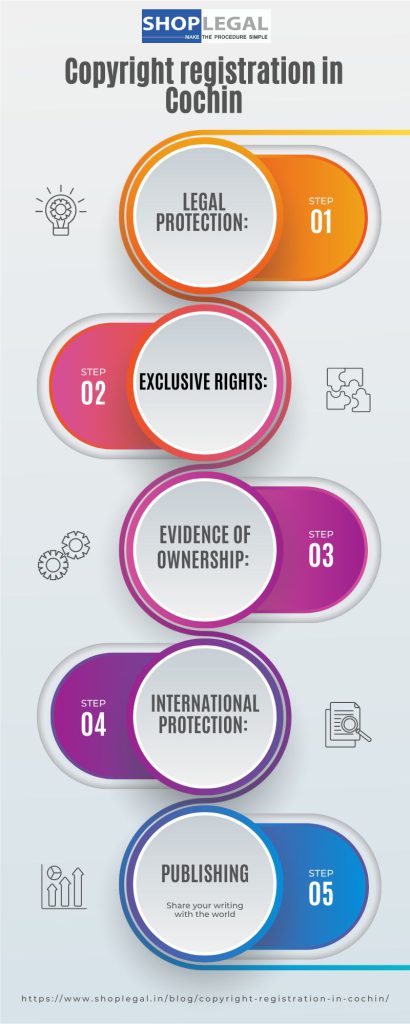
Copyright registration in Cochin provides legal protection to the owner of the original work. It establishes a legal presumption of ownership and validity, which makes it easier for the owner to enforce their rights in case of infringement.

Exclusive rights:

Exclusive rights to control the use and distribution of their work are obtained when you get Copyright registration in Cochin. This includes the right to reproduce the work, distribute copies of the work, perform or communicate the work to the public, and create derivative works based on the original work.

Evidence of ownership:

Copyright registration in Cochin provides a tangible record of ownership. This can be used as evidence in court to establish ownership and to seek legal remedies in case of infringement.

Economic benefits:

Copyright registration can provide economic benefits to the owner of the original work. It can help in licensing and monetizing the work, which can generate revenue for the owner.

International protection:

Copyright registration in India is recognized in several countries through international treaties. This provides international protection to the owner of the original work and makes it easier to enforce their rights in other countries.

Statutory damages:

Copyright registration in Cochin provides the owner with the right to claim statutory damages in case of infringement. This means that the owner can claim a predetermined amount of damages without having to prove actual loss or damage.

Injunctions:

Copyright registration provides the owner with the right to seek injunctions to prevent further infringement. This can be an effective remedy to stop the unauthorized use of the work.

Conclusion

To sum up, copyright registration in Cochin is a legal concept that protects the rights of authors, creators, and owners of original works. It grants exclusive rights to the owner and provides a legal framework for enforcing those rights in case of infringement. While copyright registration in Cochin is not mandatory, it is recommended to establish ownership and protect against potential infringement. The Copyright Act of 1957 and its subsequent amendments provide for both civil and criminal remedies for copyright infringement.

Copyright registration in Cochin

copyright registration in bangalore

Copyright registration in Bangalore


TALK TO EXPERTS


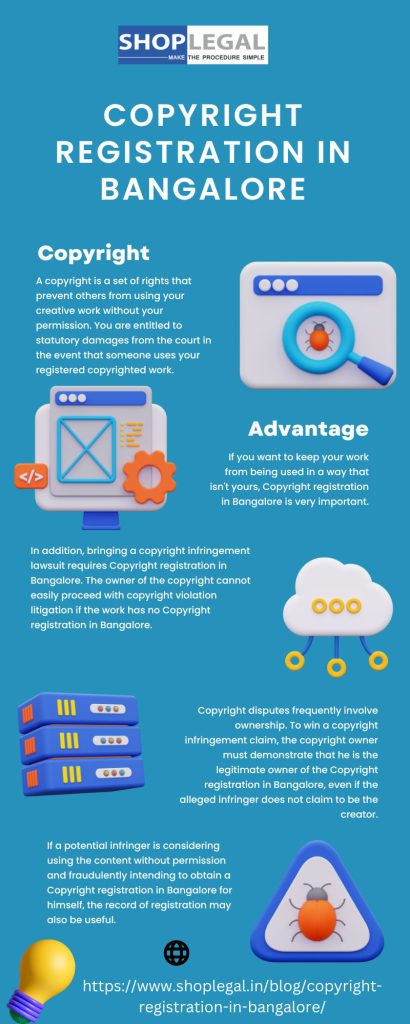
A copyright is a set of rights that prevent others from using your creative work without your permission. You are entitled to statutory damages from the court in the event that someone uses your registered copyrighted work. Find out everything there is to like about copyright registration in India by reading on.

Advantages of Copyright registration

Ability to impose copyrights through the filing of a copyright infringement lawsuit


The registrant’s certificate of Copyright registration in Bangalore serves as prima facie evidence that the creative work is original and belongs to them. If the owner of the copyright wishes to obtain a preliminary injunction against a copyright infringer, this document is absolutely necessary.

Also if you want to keep your work from being used in a way that isn’t yours, Copyright registration in Bangalore is very important. And if your work does not have a copyright registration, you will need to gather a lot of evidence before you can blame an imitator in court.

In addition, bringing a copyright infringement lawsuit requires Copyright registration in Bangalore. The owner of the copyright cannot easily proceed with copyright violation litigation if the work has no Copyright registration in Bangalore. Due to the fact that both parties can assert that they created the work first.

The equivalent was held on account of Dhiraj Dharamdas Dewani v. M/s Sonal Data Frameworks Pvt Ltd, where that’s what the court held – In the event that enlistment isn’t made and published in the authority journal, an infringer can’t be anticipated to know, nor could he at any point be credited information about the responsibility for specific copyright proprietor’s elite directly over the work, and the crook code wouldn’t be obligated to convict such an individual.

The police officer must be satisfied that a specific person (the complainant) is the owner of the copyright when such Copyright in Sound Recording has Copyright registration in Bangalore, as is clear from a reading of Section 64 regarding the power of police to seize copies of original works without authorization.

Letting people know about the ownership

Copyright disputes frequently involve ownership. To win a copyright infringement claim, the copyright owner must demonstrate that he is the legitimate owner of the Copyright registration in Bangalore, even if the alleged infringer does not claim to be the creator.

A public record of copyright ownership is established by Copyright registration in Bangalore. If original ownership is ever questioned, a public record proving a claim to a creative work will go a long way toward proving it.

If a potential infringer is considering using the content without permission and fraudulently intending to obtain a Copyright registration in Bangalore for himself, the record of registration may also be useful.

Legal proof of ownership

The capacity to inform the general public that the work is the property of an individual is the most significant advantage of Copyright registration in Bangalore. From a legal standpoint, the benefit’s subsequent legal legitimacy is the second most significant.

Copyright registration in Bangalore will safeguard the original owner in the event that a third party distributes or reworks a copyrighted work without permission.

Copyright registration in Bangalore likewise assists with killing the chance of encroachments since it turns out to be expressly certain that the overall population doesn’t reserve the option to share or revise any protected work.

Additionally, under the Copyright Act after having Copyright registration in Bangalore, the copyright holder still has legal standing if they can merely demonstrate that the infringing party had access to the original content and that their works are comparable, without having to document extensive proof.

Other important advantage

In order to prevent the import of unauthorized work, a copyright with Copyright registration in Bangalore must register an intellectual property right with the Customs Office.

Owners with Copyright registration in Bangalore can easily sell, license, transmit, rework, or transfer the rights to other people when they own copyright.

Additionally, a Copyright Public Performance owner is not required to file a case in the location of the infringer or where the infringing activity is taking place.

Thus Copyright registration in Bangalore is essential.

What to do when you get copyright strike on YouTube?

Because it affects your entire channel rather than just a single video, a copyright strike is significantly worse than a copyright claim.

However, how is a copyright strike obtained? If, on the other hand, a video you’ve uploaded contains content that is in violation of copyright laws, you will receive such a strike. It can be used to prevent you from using images, music, video clips, or anything else.

Because it affects your entire channel rather than just a single video, a copyright strike is significantly worse than a copyright claim.

However, how is a copyright strike obtained? If, on the other hand, a video you’ve uploaded contains content that is in violation of copyright laws, you will receive such a strike. It can be used to prevent you from using images, music, video clips, or anything else.

How to handle it?

A copyright strike can be dealt with in three ways. To begin, you have the option of accepting it and simply waiting for it to expire while facing the consequences.

Second, you can get a withdrawal — and that implies you get the individual who gave the protest to withdraw it. You need to get in touch with the copyright striker, talk to them about why they believe you violated their copyright that had Copyright registration in Bangalore, try to resolve the issue behind the scenes, and get them to retract their complaint in order to accomplish that.

Thirdly, you can argue against a copyright strike. Fair use is sometimes the content you are accused of using without permission.

Don’t put off uploading to YouTube because you’re worried about copyright.

Although familiarizing yourself with copyright may initially appear intimidating, you should not be afraid of the subject. You can get assistance with the subject from a plethora of useful online resources and even more videos on YouTube.

There are videos from creators on the platform that offer their perspective or personal experiences with copyright and can get Copyright registration in Bangalore, as well as uploads made by YouTube itself with the intention of assisting creators in navigating the issue.

It may appear to be a difficult subject, but in the end, it can be fairly straightforward: Don’t use anything you don’t own. In that case, obtain permission from the original owner of the Copyright registration in Bangalore.

What all can get Copyright?

Computer programs

Computer program to sell or give on commercial rental, or to perform or do such acts specified in relation to literary, dramatic, and musical works. All these can get Copyright registration in Bangalore.

Note-Business rental doesn’t have any significant bearing in regard of PC programs where the PC program isn’t the fundamental object of rental.

Cinema

Cinematograph Films and Sound Recording Making a copy of the film, selling it or renting it, and distributing the film or sound recording to the general public are all examples of cinematography. To offer a copy of the sale recording for sale, rent, or sale you need Copyright registration in Bangalore.

About Us

We are the best service providers. And we usually are involved in company registration, dsc registration and IPR registration services. Also we offer services at an affordable cost with a team of experts.

Copyright registration in Bangalore

Copyright automatic in India


Copyright enlistment in India gives financial freedoms to the makers of materials like writing, workmanship, music, sound accounts and movies and broadcasts; hence empowering them to control the utilization of their material in various ways, for example, by making duplicates, giving duplicates to general society, acting out in the open, telecom and utilize on the web. It likewise gives moral privileges to be recognized as the maker of particular sorts of material and to have a problem with its twisting or its mutilation. (Material safeguarded by copyright is named as “work”).

Copyright doesn’t safeguard thoughts, names or titles. The motivation behind Copyright regulation in India is to permit Copyright registrants to acquire monetary prizes for their endeavors and to empower future imagination and the improvement of new material which benefits everybody. Copyright material is generally the aftereffect of inventive abilities or potentially critical work as well as venture, and without security, it would regularly be exceptionally simple for others to take advantage of material without paying the maker. Most employments of Copyright material thusly require authorization from the Copyright proprietor. Anyway there are sure exemptions where a few minor uses may not bring about Copyright encroachment.

Copyright insurance is automatic when there is a record in any type of the material that has been made. There is an arrangement to register the Copyright under the Indian Copyright Act, albeit this is intentional.

Proprietor of a Copyright

  • On account of an abstract, sensational, melodic or imaginative work, the common principle is that the creator, for example the individual who made the work is the primary proprietor of the financial freedoms under Copyright. In any case, where such a work is made throughout business, the business is the principal proprietor of these freedoms, except if a consent running against the norm has been made with the creator.
  • On account of a movie, the important chief and the movie maker are joint creators and first proprietors of the financial privileges, and comparable arrangements as alluded to above apply where the chief is utilized.
  • On account of a sound recording, the record maker is the creator and first proprietor of Copyright; on account of a transmission, the telecaster; and on account of a distributed release, the distributer.

Copyright is, be that as it may, a type of property which, as actual property, can be traded, acquired or in any case moved, entirely or partially. In this way, some or each of the financial privileges may along these lines have a place with somebody other than the primary proprietor. Conversely, the ethical freedoms concurred to creators of abstract, emotional, melodic and imaginative works and movie chiefs stay with the creator or chief or pass to their main beneficiaries on death. Copyright in material created by a Government office has a place with the Government of India.

  • Copyright proprietors by and large reserve the option to approve or deny any of the accompanying comparable to their works:
  • Replicating of the work in any capacity E.g. copying/recreating a printed page by penmanship, composing or examining into a PC or taping live or recorded music.
  • Giving duplicates of the work to people in general.
  • Public conveyance of talks or addresses and so on
  • Broadcasting of the work, sound/video or remembering it for a link program.
  • Making a transformation of the work, for example, by deciphering an artistic or sensational work, interpreting a melodic work or changing over a PC program into an alternate code or code.

Copyright infringement

Copyright is encroached when any of the above acts are managed without authorisation, whether straightforwardly or in a roundabout way, or whether considerably (to a limited extent) or in entire, except if what is done falls inside the extent of special cases for Copyright encroachment allowing specific minor employments of material.

There are various special cases for Copyright that permit restricted utilization of Copyright works without the consent of the Copyright proprietor. For instance, restricted utilization of works might be feasible for exploration and private review, analysis or survey, announcing recent developments, legal actions, instructing in schools and other instructive foundations and not-revenue driven playing of sound accounts.

Yet, assuming you are replicating a lot of material or potentially making numerous duplicates then you might in any case require consent. Additionally where a Copyright exemption covers distribution of passages from a Copyright work, it is by and large important to incorporate an affirmation. Some of the time more than one special case might apply to the utilization you are considering.

Exemptions

Exemptions for Copyright don’t for the most part give you privileges to utilize the Copyright material; they simply express that specific exercises don’t encroach Copyright. So it is conceivable that an exemption could be abrogated by an agreement you have marked restricting your capacity to do things that would some way or another fall inside the extent of a special case.

It is vital to recall that simply purchasing or claiming the first or a duplicate of a Copyright work doesn’t give you the consent to utilize it the manner in which you wish. For instance, purchasing a duplicate of a book, CD, video, PC program and so on doesn’t really give you the option to make duplicates (in any event, for private use), play or show them in broad daylight. Other ordinary employments of Copyright material, for example, copying, examining, downloading from a CD-ROM or online data set, all include replicating the work. In this way, consent is by and large required. Likewise, utilization past the particulars of a concurred permit will require further authorization.

Copyright law needs an amendment

The most common way of enrolling copyright is basic; it doesn’t include any assessment by the Registrar of Copyrights. It is only to look for any protests on the responsibility for guaranteed copyright.

Despite the fact that Sanjay Soya has revised this irregularity, the issue runs further. It isn’t remarkable for authorization specialists, like the police and the traditions, to reject implementation of unregistered protected work, just due to obliviousness of the settled place of regulation going against the norm. Despite the fact that the decisions like Sanjay Soya clarify the right place of regulation, the permeation of this law to the lower rungs of the authorization organization stays far fetched.

The arrangement then, at that point, lies in official revision. In this way, for legitimate assurance, the Parliament of India ought to alter the Copyright Act to explicitly explain that copyright enrolment isn’t needed for requirement.

Nonetheless, without even a trace of express arrangements in the Copyright Act or somewhere else, there is space for unbridled watchfulness with respect to the implementation specialists to decide responsibility for. Thusly, on account of unregistered protected work, it would be prudent for the capable position to give restricting rules to the implementation specialists to decide copyright proprietorship for various protected works. This will reinforce the legitimate assurance and consistency planned to be accomplished by the law.

International copyright registration


Global Copyright law doesn’t exist! Intellectual property law is regional and public in scope. Security against unapproved utilization of a work in a nation will rely upon the public laws of that country. Be that as it may, worldwide copyright arrangements and shows have significantly improved on the method involved with conceding insurance to unfamiliar laborers. This permits makers and content proprietors in various nations to appreciate selective privileges over their work across the world.

Worldwide Copyright – Treaties and Conventions

There are various worldwide arrangements and shows that give assurance to imaginative works that are the topic of copyright. The Berne Convention for the Protection of Literary and Artistic Works is the essential global overseeing arrangement for overall copyright. Different shows that India is a party to incorporate the Universal Copyright Convention, Trade-Related Aspects of Intellectual Property Rights (TRIPS) Agreement and Convention for the Protection of Phonograms against Unauthorized Duplication of their Phonograms.

Berne Convention for the Protection of Literary and Artistic Works

The Berne Convention requires security for all imaginative works in a proper medium to be programmed. This implies that no enlistment or store with an administration copyright office needs to have copyright assurance. There are, be that as it may, intentional government enlistment frameworks where copyright proprietors can enlist their works, along these lines acquiring qualification to specific advantages particularly in instances of copyright infringement.

The point of all the copyright shows/arrangements/settlement centers around the rule that the first inventiveness or works of the brain. Which is the topic of assurance under intellectual property law, ought to be dispersed and conveyed paying little heed to their public borders.2 Therefore, the basic standards on which the significant Copyright Conventions are based are:3

Principle of National Treatment – Works starting in one of the Contracting States (that is, works the creator of which is a public of such a State or works initially distributed in such a State) should be given a similar security in every one of the other Contracting States as the last option awards to crafted by its own nationals.

Principle of “Automatic” Protection – This implies that such public treatment will not be contingent upon any convention, for example Insurance should not be contingent upon consistence with any convention.

Principle of “Independence” of Protection – This implies that the happiness and exercise of the freedoms in a secured work. In a specific nation is free of the presence or nonexistence of assurance in the nation of beginning or in some other country.

 Intellectual property Law in India

The Copyright Act 1957 (the Act), upheld by the Copyright Rules 1958 (the Rules), is the administering law for copyright assurance in India. Generous revisions does to the Copyright Act in 2012. India observes a precedent-based law overall set of laws, so depends on case law to decipher and start trends in law thus the legal choices add to the wellsprings of intellectual property law in India. India is an individual from the Berne Conventions and Universal Copyright Convention. The Government of India has additionally passed the International Copyright Order, 1999. As per this Order, any work previously distributed in any country that is an individual from any of the above shows is allowed a similar treatment as though it was first distributed in Quite a while.

Application for International Copyright

By temperance of Indian being a piece of the Berne Convention, copyright insurance is that assurance is accessible in a few nations across the world, albeit the work is first distributed in Quite a while. Assurance works first distributed in Quite a while, in regard of all nations that part states to arrangements and shows to which India is a part. Hence, without officially applying for insurance, copyright assurance is accessible to works first distributed in Quite a while, across a few nations.

Hence any work which falls under the classes of writing, show, music, craftsmanship, cinematography. Further, sound accounts meet all requirements for copyright insurance. The work tried to be protected should be unique; nonetheless, it isn’t required that the work ought to have some unique idea or thought. The law is just worried about the inventiveness of the outflow of thought.

The Copyright Registration process in India administers the Copyright Act, 1957 and the Copyright Rules, 2013. Any unique creative work, cinematographic film, music arrangement, artistic/sensational work, sound recording or programming can give copyright that the work is an unmistakable articulation of an idea. A portion of the essential rules are:

An application for registration must be made on Form IV (Including Statement of Particulars and Statement of Further Particulars) as endorsed in the First Schedule to the Rules.

Every application should join by the imperative charge as in the Second Schedule either as a Demand Draft or an Indian Postal Order inclining toward the “Recorder Of Copyright Payable At New Delhi” or through E-payment. The application should contain the fundamental marks and Power(s) of Attorney.

The application ought to have by the candidate

Three duplicates of work that distribute should send alongside the application. Assuming that it is an unpublished work, a duplicate of the original copy ought to be sent alongside the application.

Following this, a Diary Number issues to follow the situation with the application which is put on a required sitting tight time of 30 days for any protests.

For no complaints, the application will give to a scrutinizer. The registration process will be finished assuming the scrutinizer neglects to track down any inconsistency in the application.

The whole process requires 8-9 months, dependent upon protests and errors. The endorsement of copyright enlistment will guarantee the security of one’s work abroad in nations. Consequently, which are involved with the Berne Convention and different shows.

Overseeing International Copyright Issues

The web makes each copyright issue a global copyright issue. Copyright-insurance content on the web can approach, utilized and shared universally. Along these lines makers should be acquainted with worldwide intellectual property law notwithstanding home-grown law by Knowing however much as could be expected with regards to homegrown intellectual property law, which probably still oversees most of one’s copyright use issues.

Staying alert that intellectual property laws change from one country to another. Contrasts might incorporate the term of copyright insurance or how reasonable use or reasonable managing work.

Understanding that there’s nothing of the sort as single global intellectual property law. In any case, there are copyright arrangements and the main one is the Berne Convention.

Remaining receptive to changes in intellectual property law at the homegrown and worldwide level. By following intriguing copyright conversations that routinely happen at the worldwide level through the sponsorship of WIPO.